ADF
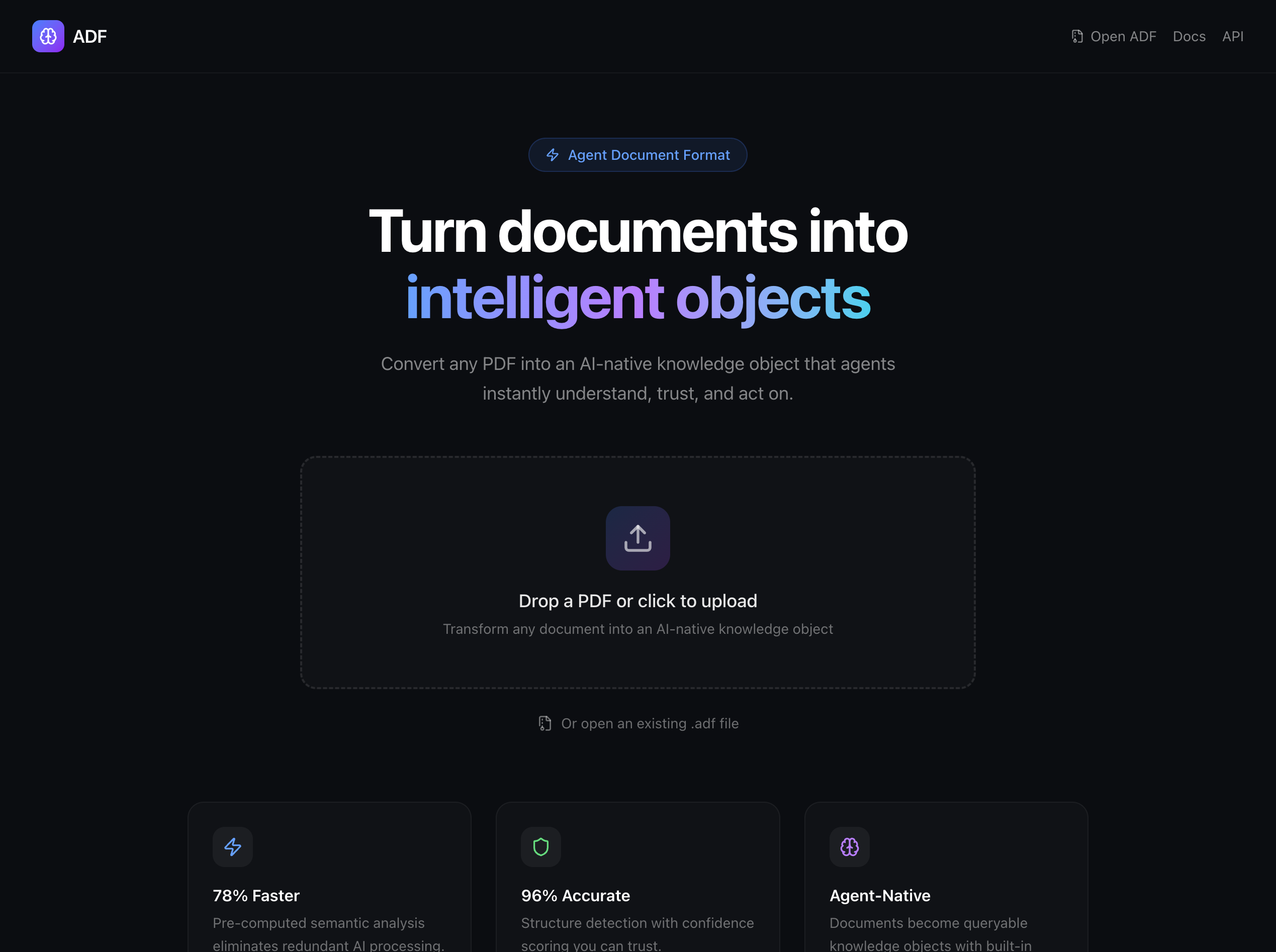
Agent Document Format
Convert any PDF into an AI-native knowledge object that agents instantly understand, trust, and act on. ADF (Agent Document Format) transforms unstructured documents into self-contained, queryable knowledge containers with pre-computed semantic analysis, confidence scoring, and agent-ready structure.
Key Features
By pre-computing semantic analysis, entity graphs, and vector embeddings at conversion time rather than at inference time, downstream AI agents can query the document 78% faster than parsing a raw PDF on the fly. The cost of heavy computation is paid once at conversion; every subsequent agent query runs against pre-built indexes.
The FastAPI extraction pipeline achieves 96% structure-detection accuracy across diverse PDF types — academic papers with multi-column layouts, legal contracts with numbered sections, scanned documents with mixed typography, and forms with table structures — using a combination of PyMuPDF geometric analysis and LLM-assisted layout classification.
Each `.adf` file is a self-contained ZIP archive containing the original PDF alongside `semantic.json` (structured headings, sections, and content blocks), `agent.json` (reading-order map and capability declarations), `graph.json` (entity relationship network), and pre-computed `embeddings.bin` (vector chunks) — everything an agent needs in a single portable object.
A drag-and-drop web interface built with Next.js 15 handles upload, triggers the FastAPI conversion pipeline, displays progress through the extraction and enrichment stages (structure detection → LLM semantic enrichment → embedding generation → packaging), and delivers the completed `.adf` file for download — end-to-end in the browser.